ZADABAR64

The SID VSTi we all wanted. And it's free.

Two instruments in one plugin: a full SID synth and the first free, open-source SID drum machine plugin, switchable from the header. A real, cycle-accurate emulation of the Commodore 64's MOS 6581 / CSG 8580 sound chip, played by a proper C64-style player routine, inside your DAW. No sample packs, no "inspired by". The chip itself. Open source under GPL-3.0.

THE FIRST FREE, OPEN-SOURCE SID DRUM MACHINE PLUGIN ►
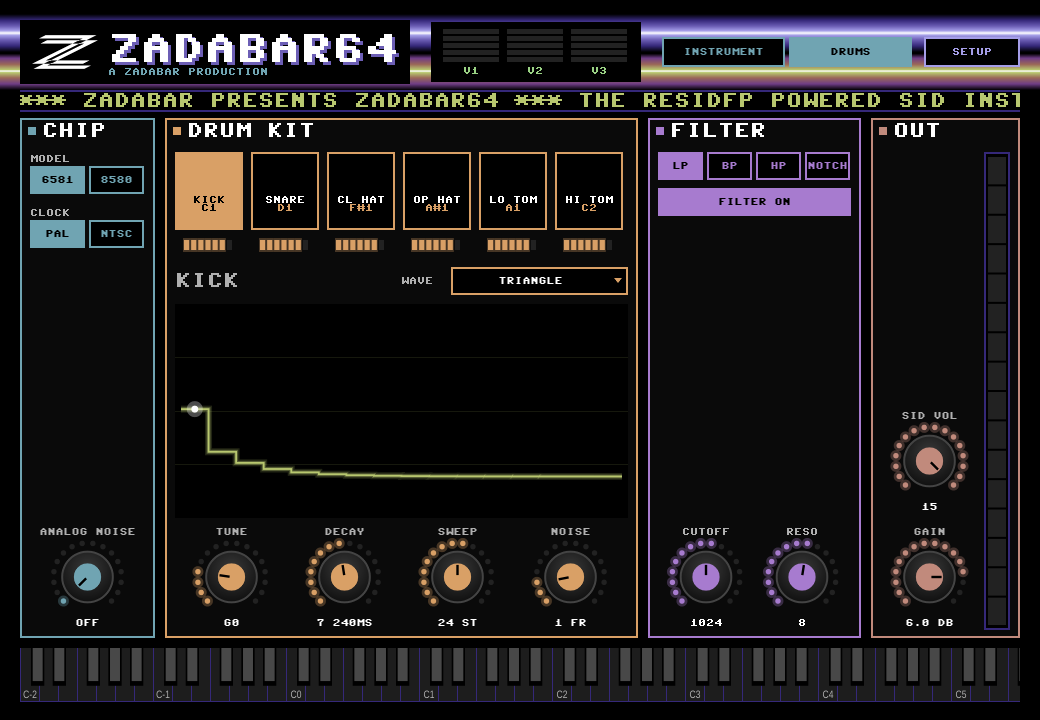
Zadabar64 drum machine mode in the Demoscene skin
6SID chips at once
18SID voices for drums
1Cycle resolution
-90dBFS noise floor
3Skins
0€Price. Forever.
FINALLY.

The first free, open-source SID drum machine plugin.
Design drums the C64 never could.

For forty years, SID drums lived in hex tables inside somebody's player routine. To change a snare you edited bytes, reassembled, reloaded and listened again. And every drum hit stole one of only three voices from your bass or your lead.

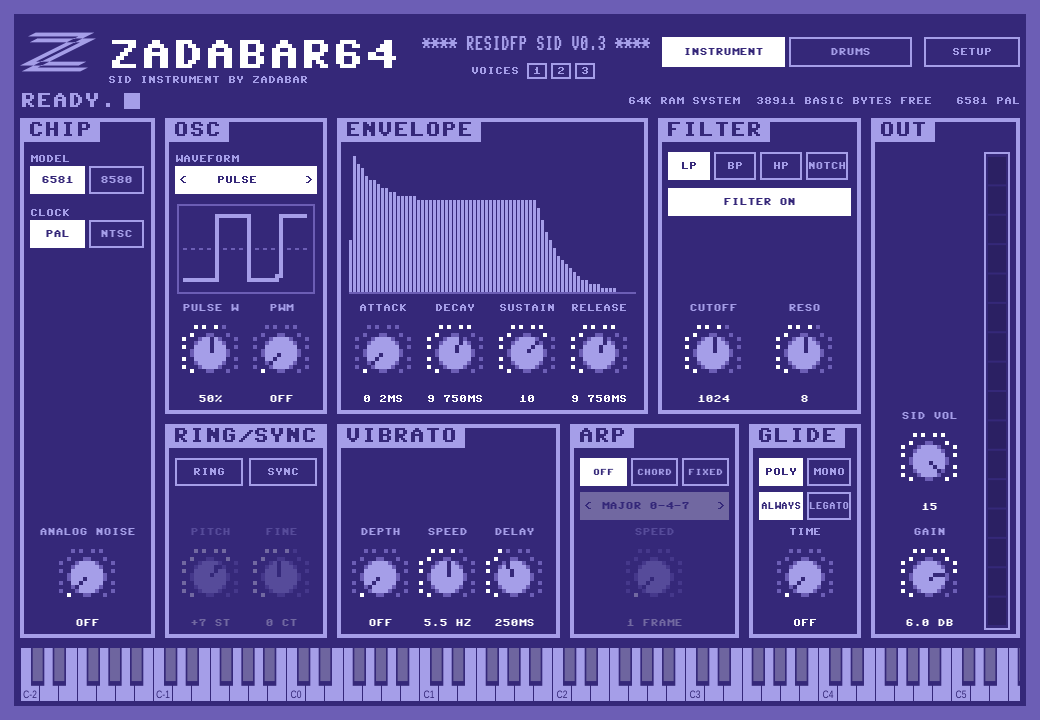
And it is not only a drum machine. Zadabar64 is a full SID instrument too: poly or mono, arpeggio chords, ring mod, sync, vibrato and glide. One click in the header switches between INSTRUMENT and DRUMS.

The drum mode is a complete SID drum machine: six drum slots, every sound built as a real per-frame SID program, every parameter on a knob, playable from your DAW, tweakable while the beat runs. It is still the real chip: the same register writes a C64 player would make, on a cycle-accurate 6581 or 8580.

This is the next level of SID composing: full SID drum kits beside your tune, without giving up a single note.
Zadabar64 drum machine: six pads with level faders, waveform selector and the drum's frame program
DRUMS ON A REAL C64ZADABAR64 DRUM MODE
VoicesBorrowed from the music: one of the three SID voices, interrupting the bass or the leadEvery drum has its own SID chip with three voices, 6 chips and 18 SID voices just for drums
At onceUsually one drum at a timeAll six can ring together and never cut each other off
VolumeOne master volume ($D418) for everythingA level fader per drum, from off to +6 dB
Sound designHex tables in assembler, reassemble, reloadTune, decay, sweep, noise frames and wave on knobs, live, automatable
TimingADSR bug: a hit can start up to 33 ms lateEvery hit on time, with no added latency (0 late or swallowed hits out of 72 in our tests)
ChipWhatever is inside your machine6581 or 8580, PAL or NTSC, plus the SID filter, one click away

Tune

C0 – C8

The body pitch, from sub-bass kicks to tiny hi-hats.

Decay

0–15 · 6 MS – 24 S

The SID's own decay/release rate, with real timings.

Sweep

0–48 SEMITONES

The pitch drop, falling a little every frame. Kicks and toms live here.

Noise

0–8 FRAMES

A noise burst before the body: the click, the snap, the stick.

Wave

TRI SAW PULSE NOISE HUBBARD

The body. "Hubbard" alternates noise and pulse every frame: the snare trick.

Level

OFF – +6 DB

Per drum. Impossible on one SID, natural with one chip per drum.

SID DRUM DESIGNER · FRAME PROGRAM
DRUM
TUNE
DECAY
SWEEP
NOISE
WAVE

BROWSER PREVIEW: SIMPLE WAVES ON THE REAL 50 HZ FRAME GRID, FOLLOWING ZADABAR64'S DRUM RULES. THE PLUGIN PLAYS IT ON THE SID.

01

Beyond the original

An open hat ringing over a closed hat, a kick under a tom roll, six drums each at its own level: things a single C64 could not do. Every one of them still comes out of a SID.

02

Your sound, not a preset

The Hubbard snare is only a starting point. A saw kick, a pulse tom, an eight-frame noise crash: every drum is yours to design, and every change is heard on the next hit.

03

Made for composing

General MIDI drum notes, so your existing patterns just play. Clickable pads to audition, a live view of the frame program, and every knob can be automated in your DAW.

HOW? SIX SIDS RUNNING AT ONCE →
LOAD"$",8 · LIST OF FACTORY PATCHES

Hear it.
Straight out of the chip.

Every factory patch and drum kit that ships with Zadabar64, played by the plugin's own engine: the same player routine, the same reSIDfp chips you get in your DAW. No reverb, no delay, no samples. Just SIDs.

Instrument patches

Drum kits

Rendered offline by the real Zadabar64 processor (v0.3, reSIDfp 1.3.0, PAL, 48 kHz): the factory patch is loaded, a short MIDI phrase is played, and the output is written to disk. The only processing is a trim of the silence at the end and peak normalisation to -1 dBFS, so the clips play at similar volumes. The SID output is mono, like the real chip. Drum kits play a GM drum pattern at 124 BPM, with a tom fill at the end.

SYS 49152

Not a sampler.
A player routine.

Every SID tune you ever loved was made by a tiny 6502 program that poked numbers into 29 sound registers at $D400, fifty times a second. Zadabar64 works the same way.

Your MIDI notes go into a built-in player routine. It computes frequency words for the chip's clock, sets gate bits, sweeps pulse width, vibrato and portamento at the C64 frame rate, and writes real register values into the emulated SID. The chip does the rest, with all its quirks, grit and filter weirdness intact.

MIDI note→player @ 50/60 Hz→$D400–$D418→reSIDfp→your DAW

The window on the right is what that looks like: register writes, frame by frame. (It is a simplified browser re-enactment, but the numbers are real PAL frequency words.)

MONITOR · $D400FRAME 0000
DRUM MODE

Six SIDs.
Running at the same time.

Here is a classic SID problem: the chip has exactly one master volume, the lower nibble of $D418, shared by all three voices. There is no way to make the snare quieter than the kick on one chip.

So in drum mode, Zadabar64 does something no C64 could: it gives every drum its own complete SID chip, six of them, and mixes them with a per-drum level fader. Every chip that is sounding is clocked at 985,248 cycles per second (PAL), live, in your plugin slot; a chip with nothing to play sleeps. Drums never cut each other off, and a typical beat costs about 20 % of one CPU core.

SID #1KICK
$D418 = $0F
VOICE 1IDLE
SID #2SNARE
$D418 = $0F
VOICE 1IDLE
SID #3CL HAT
$D418 = $0F
VOICE 1IDLE
SID #4OP HAT
$D418 = $0F
VOICE 1IDLE
SID #5LO TOM
$D418 = $0F
VOICE 1IDLE
SID #6HI TOM
$D418 = $0F
VOICE 1IDLE
KICK
SNARE
CL HAT
OP HAT
LO TOM
HI TOM
PER-DRUM
GAIN
↓
6 × SID
MIXED
↓
STEREO OUT

SILENCE
DIGITAL ZERO
01

Real per-drum levels

Kick loud, hats quiet, each with its own fader, without ever leaving authentic SID territory. Every drum still comes out of a real (emulated) chip voice.

02

Frame programs, Hubbard style

Each drum is a little per-frame SID program: tune, decay, pitch sweep, noise frames and waveform, including the noise-to-pulse "Hubbard" snare trick. The drum view shows the program step by step.

03

Never late, never choked

Every drum has its own chip, so drums never cut each other off. Inside its chip a drum rotates over the three voices and arms the next one in advance, which beats the SID's ADSR bug: every hit on time, no latency. Mapped to General MIDI drum notes, with clickable pads to audition.

POKE 54296,15

How accurate?
Cycle accurate.

The sound engine is reSIDfp, the emulator inside sidplayfp, built on Dag Lem's reSID and refined by Antti Lankila and Leandro Nini. It does not imitate the SID sound. It simulates the chip, one clock cycle at a time.

Every cycle

The emulated chip runs at the real C64 clock: 985,248 Hz PAL or 1,022,727 Hz NTSC, switchable. Oscillators, envelope generators and the filter advance cycle by cycle, then the output is resampled to your DAW's rate.

Both chips, measured

Choose the original MOS 6581 with its dirty, nonlinear analog filter, or the later CSG 8580 with its cleaner, brighter one. The filter models and combined waveforms come from analysis of real chips.

The famous bugs too

The SID's ADSR bug is emulated, not fixed: on real hardware a note can start up to 33 ms late. The drums beat it the way C64 musicians did, with zero latency: every drum rotates over three voices and arms the next one in advance, so every hit lands on time. For the instrument, keep the bug for authenticity (Live), or switch to Tight for a hard restart before every note, with 40 ms latency your DAW compensates.

Combined waveforms

Triangle, saw, pulse, noise, plus the combined waveforms that only exist because of how the real chip's oscillator outputs collide. Pulse width with PWM sweep at the frame rate.

Real filter registers

Low-pass, band-pass, high-pass and notch, with the real 11-bit cutoff and 4-bit resonance. Values on screen are the values in the registers. No smoothing lies.

Quiet when it should be

A real 6581 leaks oscillator hum. Zadabar64 stops released voices the way C64 music drivers did, and a chip with nothing to play is not clocked at all: silence is digital zero. Want the vintage hiss back? Turn up ANALOG NOISE.

MOS 6581 (1982)CSG 8580 (1987)
FilterWarm, distorting, nonlinear; the sound of the classic eraCleaner, more linear, more resonant
Combined wavesWeaker, quirkierLouder and more usable
Voltage12 V9 V
In Zadabar64One click in the CHIP panel. Same tune, different decade.
ENVELOPE LAB · REAL SID TIMINGS
NEW IN V0.3 · $D404 BITS 1 AND 2

Ring. Sync.
Vibrato. Glide.

On a real SID, voice 1 can be ring-modulated or hard-synced by voice 3. Brilliant for one-voice tricks, chaos in a chord: voice 3 is busy playing some other note.

So when ring mod or sync is on, Zadabar64 gives every instrument note its own SID chip. Voice 1 plays your note. Voice 3 runs silently at MOD PITCH above it, muted with the chip's own 3OFF bit ($D418 bit 7), the trick C64 musicians used. Ring mod and sync work on every note of a chord, at exactly the interval you choose. With both off, the three notes share one chip, just like on a real C64.

Ring modulation

Bells, gongs and metal. The note is multiplied with the modulator: sum and difference frequencies, nothing harmonic about it. It works on the triangle wave, just like on the real chip, and the panel tells you when it can't.

Hard sync

The modulator restarts the oscillator every cycle, so the pitch stays on your note while MOD PITCH sweeps the tone. The classic screaming sync lead, one knob away.

Vibrato

Depth, speed and delay. Updated once per frame, 50 times a second, like every C64 player routine. You can hear the steps, and that is the point.

Glide

Portamento with a time knob, on every note or only when you play legato. Slides happen frame by frame, exactly like a tracker would do it.

Poly or mono

Three notes at once, or MONO with last-note priority: overlapping notes slide without retriggering the envelope. Lead lines, Hubbard style.

Measured, not guessed

Every feature was checked with offline renders: ring sidebands where they belong, sync partials on the note, vibrato at the set speed after the set delay, the muted modulator at -105 dB.

NEW · THE C64 CHORD

One voice.
Whole chords.

The sound of a thousand C64 tunes: a chord played as a buzzing arpeggio on a single voice, switching notes every frame. The SID had three voices, so musicians made one voice do the work of three.

Zadabar64 does it the way the player routines did. The frequency register jumps once every 1 to 4 frames (1/50 s on PAL, 1/60 s on NTSC), counted from the moment the note starts. The gate stays open, so one envelope runs through the whole chord, and the chord keeps cycling while it fades out.

CHORD mode

Hold a chord, hear the arpeggio. Every key you hold becomes a step, lowest note first, all on one voice. Change the chord while it plays and the new note joins the cycle without restarting the envelope.

FIXED mode

Every key plays a pattern: major, minor, octave, fifth, power, sus4, maj7, min7, dom7, diminished, two octaves. Works in poly too, and together with glide, vibrato, ring mod and sync.

Frame-exact

Measured from rendered audio: one step lasts 19.84 ms on PAL (a real frame is 19.95 ms) and 16.81 ms on NTSC (16.72 ms). The first step starts on the root and lasts exactly one frame.

See the wave

The OSC panel now has an oscilloscope. A hidden SID chip draws the real waveform: the combined waves of your chip model, the pulse width while PWM sweeps it, ring mod and sync.

Honest knobs

Controls that can't change the sound right now are dimmed: pulse width without a pulse wave, MOD PITCH without ring or sync, glide while CHORD plays.

1, 2, 3 or 4 frames

One frame per step is the classic Hubbard buzz. Two or three frames slow it down until you hear the separate notes, a favourite for leads and basses.

ARP LAB · ONE VOICE, FRAME BY FRAME
PATTERN
SPEED
CLOCK

BROWSER PREVIEW: A PLAIN SQUARE WAVE ON THE REAL FRAME GRID. THE PLUGIN PLAYS IT ON THE SID.

LIST

Three skins.
Pick your era.

Same engine, three faces. Choose on the SETUP page, and every Zadabar64 instance on your machine remembers it.

DIR "$",8

What's inside

  • Instrument mode: 3 notes, poly or mono, on one SID like a real C64 (a chip per note with ring mod or sync)
  • Arpeggio: CHORD and FIXED, 1–4 frames per step
  • Ring modulation and hard sync (MOD PITCH, MOD FINE)
  • Vibrato: depth, speed, delay
  • Glide: time, always or legato only
  • Full SID drum machine: 6 designable drums (tune, decay, sweep, noise, wave, level), each on its own SID chip
  • MOS 6581 and CSG 8580 models
  • PAL / NTSC clock
  • All waveforms, incl. combined ones
  • Pulse width + PWM sweep at frame rate
  • Oscilloscope drawn by a real (emulated) SID
  • Native 0–15 ADSR with real timings shown
  • LP / BP / HP / notch filter, 11-bit cutoff
  • Live envelope view with a dot per voice
  • Drum frame-program view
  • Output level meter
  • Live / Tight timing modes
  • Analog noise knob
  • Pitch bend, on-screen keyboard
  • Patch browser: factory patches and drum kits, save your own
  • VST3 + standalone app, 64-bit
WHOAMI

Who is
Zadabar?

Demoscene musician. Writes the music for Crisis Productions, a demogroup from Budapest, Hungary.

Zadabar64 started as the instrument he wanted for himself: the real SID, inside the DAW, playable like a synth, without giving up a single quirk. Now it is yours too, for free.

CRISIS.NFO1 BLOCKS FREE
▄████▄ ██▀███ ██▓ ██████ ██▓ ██████ ▒██▀ ▀█ ▓██ ▒ ██▒▓██▒▒██ ▒ ▓██▒▒██ ▒ ▒▓█ ▄▓██ ░▄█ ▒▒██▒░ ▓██▄ ▒██▒░ ▓██▄ ▒▓▓▄ ▄██▒██▀▀█▄ ░██░ ▒ ██▒░██░ ▒ ██▒ ▒ ▓███▀ ░██▓ ▒██▒░██░▒██████▒▒░██░▒██████▒▒ P R O D U C T I O N S GROUP .... CRISIS PRODUCTIONS CITY ..... BUDAPEST, HUNGARY MUSIC .... ZADABAR CODE ..... T0M4T0, CSEGA PLATFORM . JAVASCRIPT / BROWSER SINCE .... 2022
1ST PLACE
2024 · QBPARTY · 45 SEC FAST DEMO COMPO

GET OUT

Forty-five seconds, first place. Fast demo, browser-native.

7TH
2023 · FUNCTION · DEMO

BATTLE CRY

Shown on the big screen at Function in Budapest.

4TH
2022 · FUNCTION · DEMO

MIDLIFE CRISIS

The group's debut, and a top-5 finish right away.

DOWNLOADGPL-3.0-OR-LATER
LOAD"ZADABAR64",8,1
 
SEARCHING FOR ZADABAR64
FOUND ON GITHUB.COM/ZADABAR
PRICE ...... 0 EUR. NO REGISTRATION. NO ILOK.
FORMAT ..... VST3 + STANDALONE, 64-BIT
TESTED IN .. CUBASE 15
STATUS ..... V0.2, EARLY DEVELOPMENT
 
READY.
; OR BUILD IT YOURSELF (JUCE + LIBRESIDFP ARE FETCHED BY CMAKE)
cmake -B build
cmake --build build --config Release --parallel